The phonograph revolutionized music, changing the way people interacted and accessed it, jump-starting the modern music industry. The device was revolutionary because people were able to listen to music in their own homes. The phonograph was originally patented by Thomas Edison, yet French poet and inventor Charles Cros came up with the idea of recording music before him. Competitors made their own versions of the Edison Phonograph that were cheaper and more durable, sparking innovation in the music and recording industry. The ability to record and replay music provided radio stations with content that was sent over the airwaves. Southern Appalachian women became some of the first recorded country music artists.
The Appalachian Women’s Museum has acquired an Edison Phonograph, adding to our music room!

Phonograph History
The history of the phonograph, originally named the gramophone, goes back further than most people realize. The credit goes to Thomas Edison, but he wasn’t the first to theorize recording technology. French inventor and poet Charles Cros submitted a theory of recording sound onto a glass disc to a French academy three months before Edison. “Cros suggested that this glass could be photoengraved to produce lines in relief and somehow could be used to replay the recorded sound. He gave a copy of his paper to the French Academy of Sciences in April 1877, three months before Thomas Edison’s invention of the phonograph”. Cros’s contribution to the evolution of music recording should be noted.
Edison’s “[c]ylinders peaked in popularity” by 1905. Other inventors, like Bell, were getting into the recording music game by improving upon Edison’s phonograph technology. All of these new technologies grew in popularity. Alexander Graham Bell saw a business opportunity to better Edison’s invention and made the graphophone. He determined that “wax was stronger than tinfoil. And wax cylinders held the grooves made by soundwaves longer. It created a clearer and stronger sound. Wax allowed for multiple replays of the record”. Bell improved on Edison’s original invention, making the records more durable. Edison responded.
Edison reinvented the phonograph in response. He decided to invest in revamping his phonograph to make it a more appealing product, eventually developing three different versions. The new Edison Phonograph used a more durable quarter-inch thick disc and improved the stylus technology. The stylus on his new phonograph “would bob up and down in the groove, rather than from side to side or laterally. Ten-inch records would run for 5 minutes per side at approximately 80 r.p.m.”. Initially, the phonograph was expensive, ranging in price from 150 to 250 dollars, making them cost prohibitive. The phonograph cabinets were large and they were unattractive to the public eye. In response to public opinion, they made smaller, less expensive models. Yet, The records were more costly than competitors’ because of the chemical process and they were proprietary. In other words, you have to buy Edison records to use the Edison Phonograph. Edison’s improvements were noteworthy, but they didn’t solve the market issues.
To entice the public to purchase an Edison Phonograph, Edison needed to highlight the quality of sound on the new “diamond” disc player. He showcased the quality of sound to the public by holding tone tests. Between 1915-1925, Edison, the forever showman, held recitals where artists would sing alongside their Edison recordings. The “tone tests were received and interpreted in a number of ways; audience members actively engaged with the format imposed by the Edison company and made it their own”. The public received the phonograph’s new sound well and some were not able to tell the difference between the recording and the live performance. “It would be easy to credit the success of tone tests to the Edison company’s strategy of having the performers consciously imitate the sound of their recordings, but this simple explanation fails to recognize the fact that Edison Diamond Discs represented the pinnacle of the technology of acoustical recording and sounded far better than anything that had preceded them”. The sound of the Edison Phonograph far exceeded the competition, showing its value.
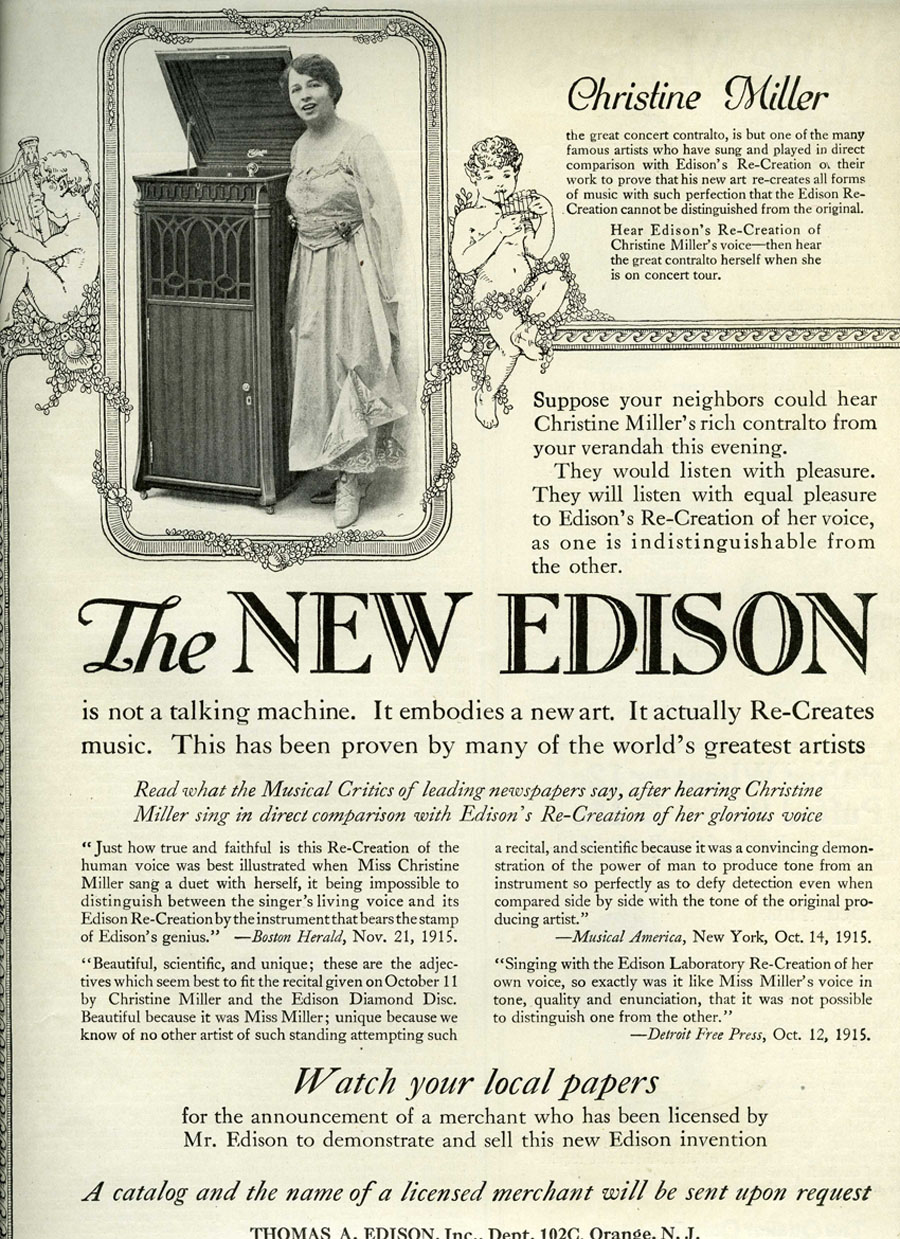
Anna Case’s Re-Created Voice reviewed by Musical Critics of leading newspapers, August 1916 McClure’s (PM-2020)
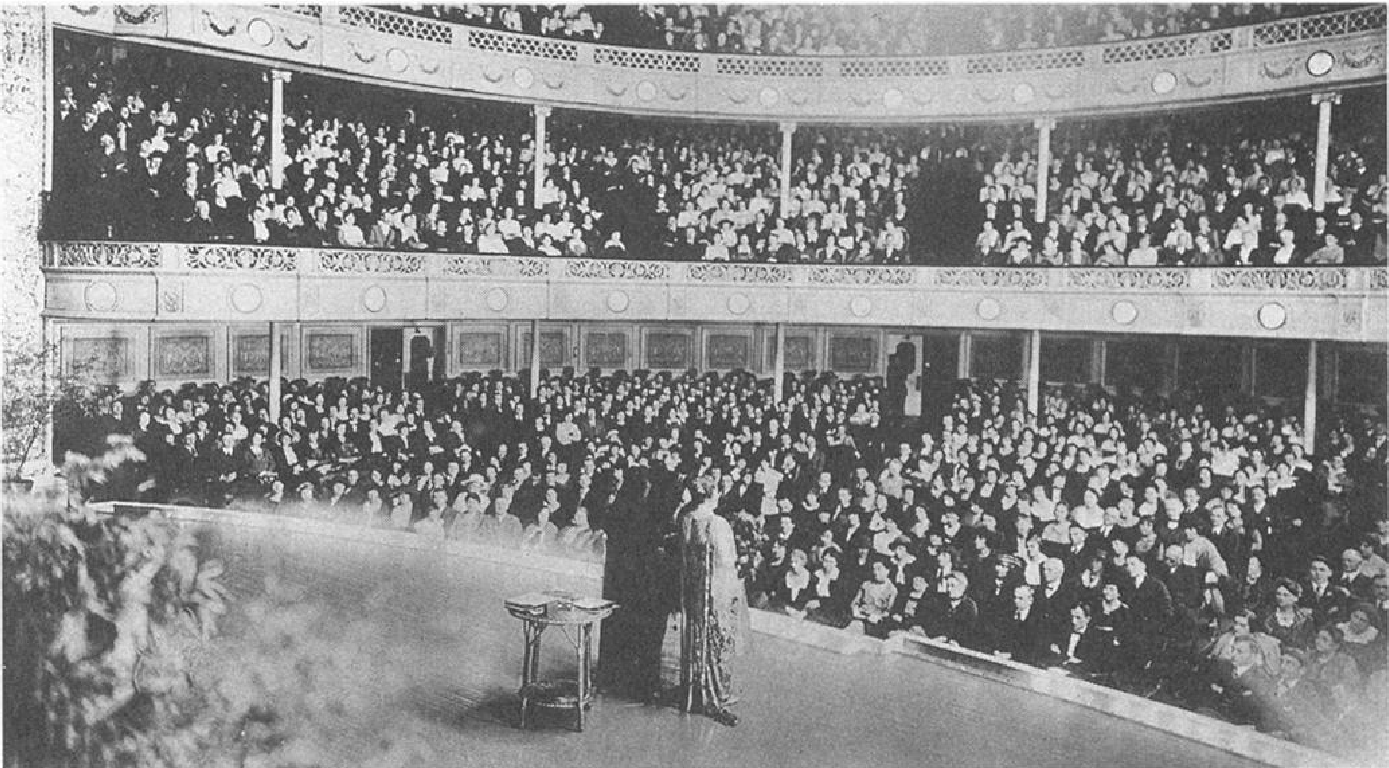
Marie Rappold tone test, Carnegie Music Hall, Pittsburgh, 30 Sept. 1919. Courtesy
Edison National Historic Site
The value of the Edison Phonograph was not limited to money but embedded music’s cultural significance into American homes. Author and Professor at Temple University, Miles Orvell, poses the question about American culture, “‘How has the machine, with its power to produce replicas and reproductions, altered our culture?’”. The ability to record and sell musical recordings became an increasing desire for the American public. The Diamond Disc player was also used in the burgeoning radio industry, expanding airwaves into American living rooms. Starting a whole new culturally dominant industry in the United States.
An Industry Jumpstarted
Before you could listen to music on the radio or on Spotify “if you wanted to hear a song, you had only one option: live. You listened while someone played it, or else you played it yourself”. The home was the place you went to hear and play music, but “that changed in 1877 when Thomas Edison unveiled his phonograph. It wasn’t the first such device to record and play back audio, but it was the first generally reliable one: scratchy and nearly inaudible by modern standards, but it worked. Edison envisioned a welter of uses, including for business”. The phonograph transformed and spread the musical culture of Appalachia to the rest of the country. Edison’s device spread musical genres and culture throughout America. People were now able to learn about the culture of Southern Appalachia from what they heard in a song. “Country’s development was made possible partly by the invention of the phonograph and its ability to record music. In the early 1920s the traditional string-band music of the Southern mountain regions began to be commercially recorded”. Southern Appalachian Women participated in the expansion of mountain music.
Women of Country Music and Appalachian Culture
The history of women in Southern Appalachia is obscured by the fact that so much of it is written by men. “Women have been extras, hidden behind quilts and sunbonnets in tradition-bound domestic roles that supported the husbands, sons, and fathers as they transformed the region and made its history”. However, the importance of women’s role in the preservation of southern Appalachian culture cannot go unnoticed. Samantha Baumgarner was born in Jackson County and grew up playing banjo and the fiddle. The first female recorded country musicians, Samantha and her friend Eva Davis, landed a recording deal with Columbia Records, traveling to New York in 1924. Samantha went on to have a long and successful career. She was invited to perform at the “White House concert of American music hosted by Franklin and Eleanor Roosevelt in 1939 – special guests included King George VI and Queen Elizabeth of England” (Samantha Baumgarner). In 1929, Samantha performed at Bascom Lamar Lunsford’s first Mountain Dance and Folk Festival in Asheville. Samantha continued performing there up until the year before she passed away on Christmas Eve in 1960. She is remembered as one of the greatest country and folk music stars and a pioneer of the country music industry. A representative of Columbia Records said that artists like Samantha sing and play “real traditional American music, songs that are part of our national musical lore” (Samantha Baumgarner). Her records were most likely played on Edison Phonographs in Jackson County. Appalachian women played a pivotal role in the growing American culture spreading musical traditions across the nation.
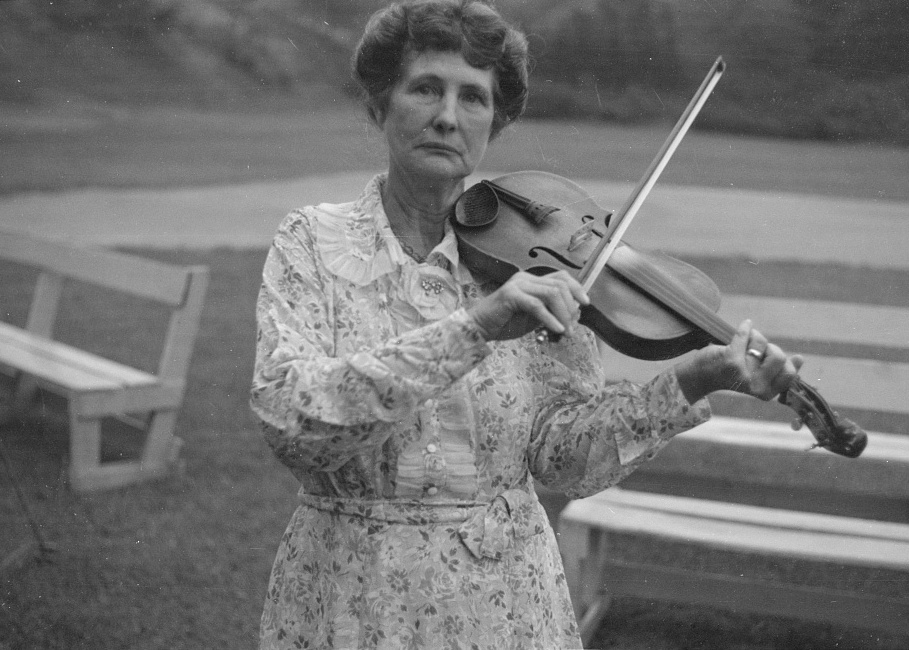
Library of Congress, Prints & Photographs Division, FSA/OWI Collection, LC-DIG-fsa-8a17155
The phonograph started the recording music industry, changing how people got their music and the culture. Thomas Edison wasn’t the first one to come up with the idea for recording and playing music, but he was the one who first invented it in the United States. Famous competitors, like Alexander Graham Bell, sought to cash in by improving the invention. Edison was able to stay in the game by improving his phonograph’s technology and sound. The great showman sold his new idea with his tone tests, allowing “Edison customers in small towns and big cities alike both to acquire and publicly display their ‘musical culture”. The improvement of his invention led to innovation and the creation of the modern music industry. With a drop of a stylus, music entered lives and living rooms across the country in a new and different way. Genres were created, music stars were born, and its impacts were felt everywhere. Appalachian women like Samantha Baumgarner rose to fame showcasing her musical talents on a huge scale, cutting records, and playing for unique audiences like the King and the Queen of England. Aunt Sam pushed cultural barriers by succeeding with her talents. The Edison Phonograph revolutionized music and American culture, forging the first record labels and providing opportunity.